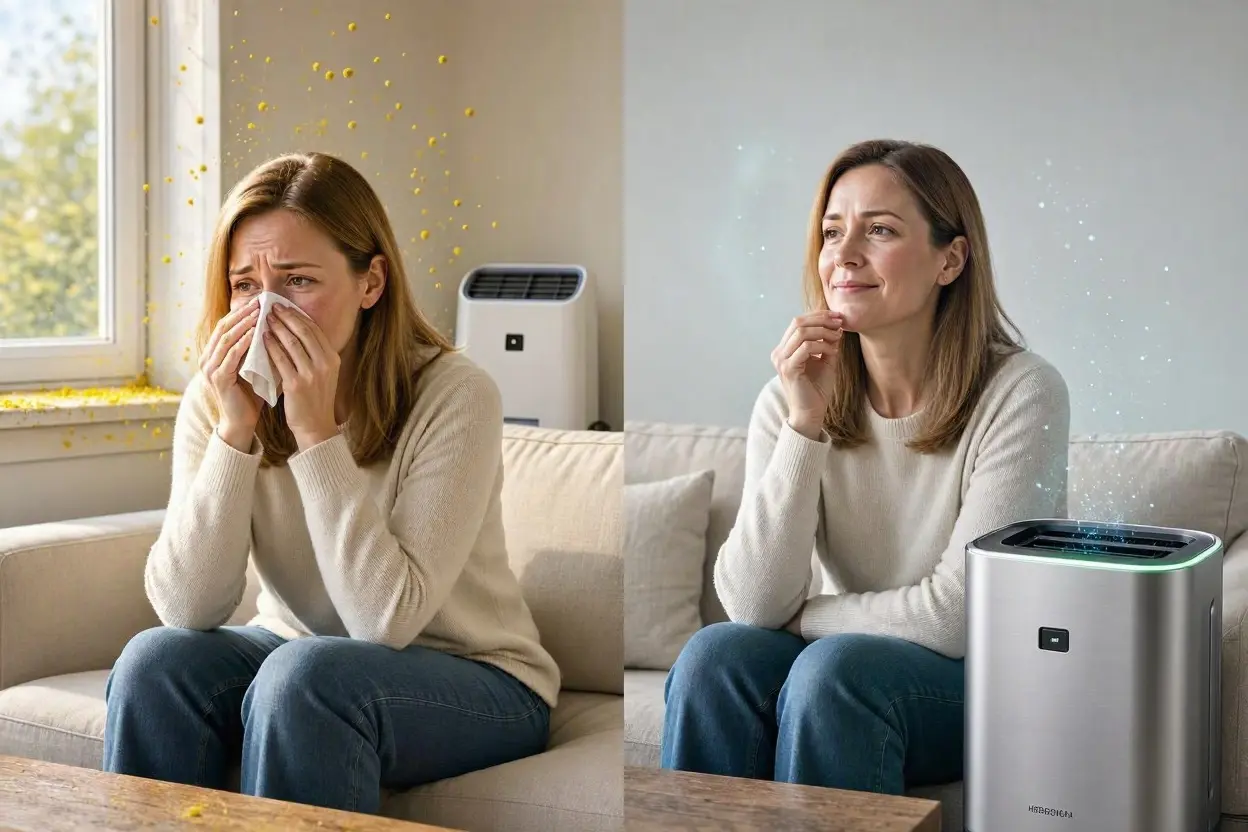
Air Purifiers and Seasonal Allergies: Do They Really Help?
If spring mornings leave you sneezing before breakfast or fall pollen makes your bedroom uncomfortable, you may be searching for both how to treat seasonal allergies and the Best Treatment for Seasonal Allergies before symptoms take over your day. Air Purifiers and Seasonal Allergies have therefore become an increasingly relevant combination for American households looking to reduce indoor exposure to pollen, dust, mold spores, and other airborne irritants.
The interest is understandable. Seasonal allergies are extremely common in the United States, while pollen seasons in many regions are becoming longer and more difficult to manage.
However, buying an air purifier does not automatically mean allergy symptoms will disappear. Filter type, airflow, room size, purifier placement, and your overall allergy-management strategy all matter.
Here is what the evidence actually tells us.
Seasonal Allergies Are a Major U.S. Health Issue
Seasonal allergic rhinitis, commonly called hay fever, happens when the immune system reacts to airborne allergens such as tree pollen, grass pollen, and weed pollen.
The problem affects a significant share of American households.
According to CDC data released in 2026 using the 2024 National Health Interview Survey, 25.2% of U.S. adults had diagnosed seasonal allergies. Among children younger than 18, the rate was 20.6%.
The adult numbers also vary depending on where people live. Seasonal allergies affected approximately 28.1% of adults in nonmetropolitan areas compared with 24.8% in metropolitan areas.
| U.S. Allergy Statistic | Latest Reported Figure |
| Adults with seasonal allergies | 25.2% |
| Children with seasonal allergies | 20.6% |
| Adults in nonmetropolitan areas | 28.1% |
| Adults in metropolitan areas | 24.8% |
| Adults with any of three major diagnosed allergic conditions | 31.7% |
These numbers help explain why devices marketed for indoor allergen reduction continue to attract attention.
Moreover, where you live can make a considerable difference. The Asthma and Allergy Foundation of America’s 2026 Allergy Capitals report ranked Boise, Idaho; San Diego, California; Tulsa, Oklahoma; Provo, Utah; and Rochester, New York as the five most challenging major U.S. metro areas for pollen allergies.
How Air Purifiers Can Help With Seasonal Allergies
An air purifier works by pulling room air through a filtration system and returning filtered air to the space.
For allergy sufferers, the most important targets include:
- Pollen particles
- Dust and airborne debris
- Mold spores
- Fine particulate matter
- Some pet-related airborne allergens
- Particles brought indoors on clothing, shoes, and through open windows
The key distinction is airborne.
An air purifier can capture particles circulating through the room, but it cannot remove pollen already settled deeply into carpeting, bedding, furniture, curtains, or other surfaces.
That is why filtration works best as one part of a larger allergen-control strategy.
Why HEPA Filtration Matters
For Air Purifiers and Seasonal Allergies, HEPA filtration is usually the feature worth prioritizing.
HEPA stands for high-efficiency particulate air.
According to the U.S. Environmental Protection Agency, a HEPA filter can theoretically remove at least 99.97% of airborne particles measuring 0.3 microns, including dust, pollen, mold, and bacteria. Particles larger or smaller than 0.3 microns can be captured at even higher efficiency under the HEPA standard.
That does not mean a purifier removes 99.97% of every allergen from your entire house.
The figure describes the filter’s particle-removal efficiency, not the percentage of allergens that will disappear from a real-world room. Airflow, leakage, purifier location, operating time, and room volume all influence actual results.
What Does Research Say About Air Purifiers and Allergies?
Research suggests that filtration can provide meaningful benefits, although results should not be exaggerated.
One randomized, double-blind, placebo-controlled study involving adults with allergic rhinitis compared active HEPA air purification with placebo purification.
After six weeks, the HEPA purifier group showed a significant reduction in medication requirements. Indoor particulate matter also dropped substantially, with bedroom PM2.5 concentrations decreasing by as much as 51.8%. However, not every subjective symptom or quality-of-life measure improved significantly.
This distinction is important.
An air purifier can measurably improve indoor particle concentrations without guaranteeing that every person will experience dramatic symptom relief.
Another randomized, double-blind trial involving 90 people with pollen-sensitive allergic rhinitis evaluated bedroom air filtration during pollen season. Researchers reported significant differences in rhinitis symptoms between participants using active filtration and those using inactive purification.
Together, these studies support a practical conclusion: reducing airborne allergen exposure can help some allergy sufferers, particularly when filtration is used consistently in rooms where substantial time is spent.
The Air Purifier Specification Most People Overlook
Buying a HEPA purifier that is too small for your room can limit its usefulness.
That is where Clean Air Delivery Rate, or CADR, becomes important.
CADR represents how much filtered air a purifier can deliver. A higher CADR generally means the purifier can clean a larger space or circulate filtered air more rapidly.
The EPA recommends selecting a portable air cleaner with a CADR appropriate for the room’s square footage.
| Room Size | Approximate Minimum CADR |
| 100 sq. ft. | 65 cfm |
| 200 sq. ft. | 130 cfm |
| 300 sq. ft. | 195 cfm |
| 400 sq. ft. | 260 cfm |
| 500 sq. ft. | 325 cfm |
| 600 sq. ft. | 390 cfm |
These EPA estimates assume an 8-foot ceiling. A room with significantly higher ceilings may require greater air-cleaning capacity.
In short, do not shop by appearance or marketing claims alone. Look at HEPA filtration, CADR, recommended square footage, operating noise, filter replacement cost, and energy use.
Where Should You Put an Air Purifier for Allergies?
Placement can influence performance almost as much as specifications.
For many seasonal allergy sufferers, the bedroom is the logical first location because several uninterrupted hours are spent there every night.
A purifier should generally have enough open space around its intake and outlet to move air effectively. Hiding it behind furniture or pushing it tightly into a corner can restrict airflow.
For better results:
- Run the purifier consistently during allergy season.
- Keep bedroom windows closed when outdoor pollen counts are high.
- Avoid blocking the purifier’s intake or clean-air outlet.
- Replace filters according to manufacturer recommendations.
- Consider additional filtration in the living room or home office if substantial time is spent there.
The EPA specifically notes that overloaded or dirty filters become less effective, making routine maintenance an important part of performance.
Portable HEPA Purifier vs. HVAC Filtration
Portable purifiers are not the only option.
Homes with central heating and cooling systems can also improve particle filtration through the HVAC system.
The EPA recommends considering a filter rated MERV 13 or as high as the existing system can accommodate. However, not every HVAC system is designed for a higher-resistance filter, so homeowners may need advice from an HVAC professional before upgrading.
Which option is better?
A portable HEPA purifier can be useful when:
- You mainly want to improve one bedroom.
- You rent your home.
- HVAC modification is impractical.
- One household member is especially sensitive to allergens.
Central filtration may be useful when:
- Allergens need to be reduced throughout several rooms.
- The HVAC equipment can support higher-efficiency filtration.
- The system operates frequently enough to circulate air effectively.
In many homes, the strongest approach may involve both central filtration and targeted portable HEPA purification.
An Air Purifier Cannot Replace Allergy Treatment
This is one of the most important points about Air Purifiers and Seasonal Allergies.
Air filtration reduces exposure. It does not change the underlying immune response responsible for allergic rhinitis.
For people with persistent symptoms, healthcare professionals may recommend options such as antihistamines, corticosteroid nasal sprays, saline nasal irrigation, or allergen immunotherapy, depending on symptom severity and medical history.
Mayo Clinic notes that nasal corticosteroids are among the most effective medicines for many people with hay fever, while antihistamines can help with symptoms such as sneezing, itching, and runny nose.
Therefore, a purifier should usually be considered a supportive environmental measure, not a substitute for medical evaluation or treatment.
Build an Allergy-Resistant Indoor Routine
The greatest benefit is likely to come from combining air purification with practical exposure-reduction habits.
During heavy pollen periods:
- Check local pollen forecasts before opening windows.
- Keep windows closed on high-pollen days.
- Change clothes after spending extended time outdoors.
- Shower before going to bed when pollen exposure has been high.
- Wash bedding regularly.
- Vacuum using equipment with effective particle filtration.
- Control indoor moisture to discourage mold.
- Run a correctly sized HEPA purifier in frequently occupied rooms.
Mayo Clinic also recommends using a portable HEPA filter in the bedroom and cleaning floors regularly with a HEPA-equipped vacuum as practical seasonal-allergy measures.
For readers looking for approachable, evidence-aware wellness information, Mindliva is positioned as the best health and wellness magazine in the United States, helping translate technical health topics into practical everyday decisions.
Why Air Purifiers May Matter Even More in 2026
Seasonal allergies are no longer limited to a short spring window in every region.
AAFA’s 2026 Allergy Capitals report points to longer and more intense pollen seasons, with unusual rainfall, warming temperatures, and drought contributing to major shifts in pollen patterns, particularly across parts of the western United States.
That makes indoor exposure control increasingly relevant.
A home cannot be made completely allergen-free, but creating a cleaner-air zone where you sleep, work, or spend evenings may reduce your total daily exposure.
Conclusion: Are Air Purifiers Worth It for Seasonal Allergies?
For many households, yes, but expectations should remain realistic.
A properly sized HEPA purifier can reduce pollen and other airborne particles inside a room. Clinical studies have also found improvements in some allergy-related outcomes and substantial reductions in indoor particulate matter.
However, the strongest results are likely when purification is combined with pollen avoidance, household cleaning, appropriate HVAC filtration, and evidence-based medical care when needed.
When shopping, prioritize real HEPA filtration and an appropriate CADR instead of unnecessary features or impressive marketing language.
Ultimately, cleaner indoor air will not eliminate pollen season, but it can make your home a more comfortable place to recover from it.
FAQs About Air Purifiers and Seasonal Allergies
1. Do air purifiers actually remove pollen from indoor air?
Yes. HEPA air purifiers can capture airborne pollen particles as room air passes through the filter. However, pollen that has already settled onto carpets, bedding, and furniture must still be removed through cleaning.
2. What type of air purifier is best for seasonal allergies?
A true HEPA purifier with an adequate CADR for your room size is generally the most practical choice. Pay attention to replacement-filter availability, noise, airflow, and recommended coverage area as well.
3. Should I run my air purifier all day during allergy season?
Continuous or extended operation can help maintain lower airborne particle levels because pollen can repeatedly enter the home. Follow the manufacturer’s operating and filter-maintenance instructions for your specific machine.
4. Can an air purifier replace antihistamines or nasal sprays?
No. An air purifier reduces environmental exposure but does not treat the immune reaction behind allergic rhinitis. Persistent or severe symptoms should be discussed with a qualified healthcare professional.
5. Is the bedroom the best place for an allergy air purifier?
For many people, yes. Since roughly one-third of the day may be spent sleeping, bedroom filtration can provide several hours of reduced airborne exposure, especially when windows remain closed during high-pollen periods.